Gunpowder, Treason and King James
Remember, remember
the 5th of November –
gunpowder, treason and plot …
Happy Bonfire night folks, stay safe and cosy out there!
Tonight I am attending a lecture at the National Library about the Gunpowder plot that was planned at the House of Parliament in London in 1606.
I wanted to write about the gunpowder plot and what happened and why 420 years later we still mark the occasion with lighting bonfires and setting off fireworks.
What was the Gunpowder Plot:
A group of unhappy Catholic rebels wanted revenge on the King.
King James 6th and 1st was due to attend the annual state opening of Parliament on this day alongside his wife Anna and their son and other members of the House of Lords.
The opening was scheduled for November 5th.
The plot for treason and assassinations were planned for at least a year in advance.
Ring leader Robert Catesby, together with his four co-conspirators—Thomas Winter, Thomas Percy, John Wright, and the most famous, Guy Fawkes who were at the heart of it.
They had met 18 months earlier in a London pub called the Duck and Drape where the plot was hatched. The group were staunch Roman Catholics angered by James’s refusal to grant more religious toleration to Catholics.
King James was Protestant and he ordered all Jesuit and Catholic priests to leave the realm. Those who refused to attend the Church of England services were given enormous fines and any catholic priests found in Britain were executed.
The plan was set: The risks were life changing, if they were caught they would have been killed for treason, but they were determined.
The state opening of Parliament is significant, because that's where three branches of parliament meet together - The Monarch, the House of Lords and House of Parliament. It was the perfect opportunity to strike.
A warren of underground tunnels were dug over many months and explosives expert Guy Fawkes was preparing for the ignition date.
Many barrels and barrels of gunpowder were in place underneath the House of Parliament in central London.
Fawkes had been hiding underneath in the tunnels stockpiling gunpowder slowly whilst above ground London slept unaware.
He had worked out that 36 barrels would be needed for the explosion to be successful.
Fawkes, adopted the false identity of John Johnson (imaginative, I know) and was closely involved in the business of digging a tunnel and calculating the requirement gunpowder.
He has extensive military experience and fought for the Catholic Spanish army in his early life.
Whereas, Thomas Percy was an aristocrat and was the logistics expert of the plot. He was part of the King's body guard team, and he created a cover story. His role meant he was given a small house close to the houses of Parliament. This house was used as their base and safe house.
The aristocratic connections and location of the house meant initially no one really cares if he was there and most definitely went under the radar.
You can imagine them shifting the high explosive barrels of gunpowder carefully down to the tunnels; a single wrong move could have blown up the entire plot.
Very risky and dangerous work!
Of course during the 1600’s in London, seeing barrels being moved was not unusual and they were a part of everyday life.
What went wrong:
However, their attempt failed… On 26 October 1605, Catholic peer Lord Monteagle was handed an anonymous letter by a servant. The letter was not signed or dated and was pretty inconspicuous.
This letter, delivered by a stranger on the road, warned Monteagle not to attend the opening of Parliament.
Of course, this letter roused suspicion.. he handed the letter to the King's Secretary and then eventually into the hands of King James himself. He pondered on the letter for a few days, not reacting right away…
However he decided to act on it, after all his own father Lord Darnley was killed in a gunpowder plot in Edinburgh. He was a likely target himself.
On 4 November men loyal to the king searched the vaults of Parliament and found a large pile of firewood in a cellar.
Fawkes himself was also discovered claiming he was called John Johnson, Fawkes said that the firewood belonged to his master Thomas Percy. They did not care to investigate the pile of wood further and took Guy Fawkes for his word. So they went back to the King to report their findings.
Dissatisfied with their initial search, he ordered his men to search again and this time look underneath the large pile of firewood.
He has known Percy was a Catholic and had met him previously and was suspicious of his motives.
The men returned on the eve of Tuesday November 5th and this time they were more thorough.

Upon arrival in the cellar - Fawkes was found dressed in a cloak and hat, wearing boots and spurs and carrying fuses and matches… ready to go!
Of course the plot has been unravelled, the jig was up!
He was arrested. 36 barrels of gunpowder were carefully removed and the news was past on to the King.
Guy Fawkes was taken to the prison where he was brutally tortured and eventually revealed the name of his co-conspirators. He was shackled at the ankles and wrists and stretched out in unimaginable pain. You can see online his before and after signature, it really shows how bad things must have been!
As for the rest of the plotters…
Catesby, Percy, Jack and Kit Wright were killed while attempting to escape the authorities, but the surviving eight plotters were captured and eventually found guilty of treason on Monday 27 January 1606.
So why do we celebrate?
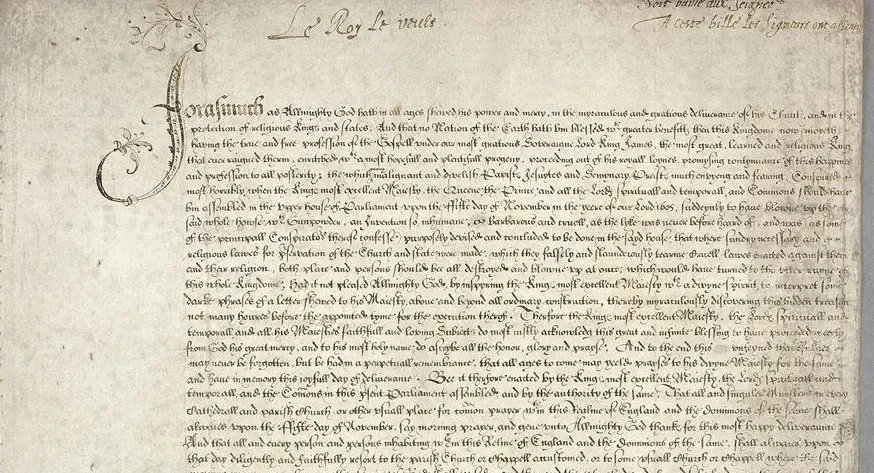
King James wanted to show that it was an Act of God that saved him and his family from the explosion and that because he was so wise to the plotters he announced to the country he outsmarted the plotters.
News pamphlets were sent out across the country declaring what could have happened.
An Act of Parliament passed in the months following the plot ensured that the failure of the Gunpowder Plot would be marked every year. Church attendance on 5th November was made compulsory under the terms of the act, and congregations had to give thanks for the failure of the conspirators.
Even today, the tradition is upheld that the Yeomen guards will search the parliament building on the night before November 5th as a nod to the gunpowder plot. They undertake the search with lanterns and it is rather symbolic.
So the next time you attend a bonfire and fireworks display, give a nod to King James and the gunpowder plot that never actually happened.